
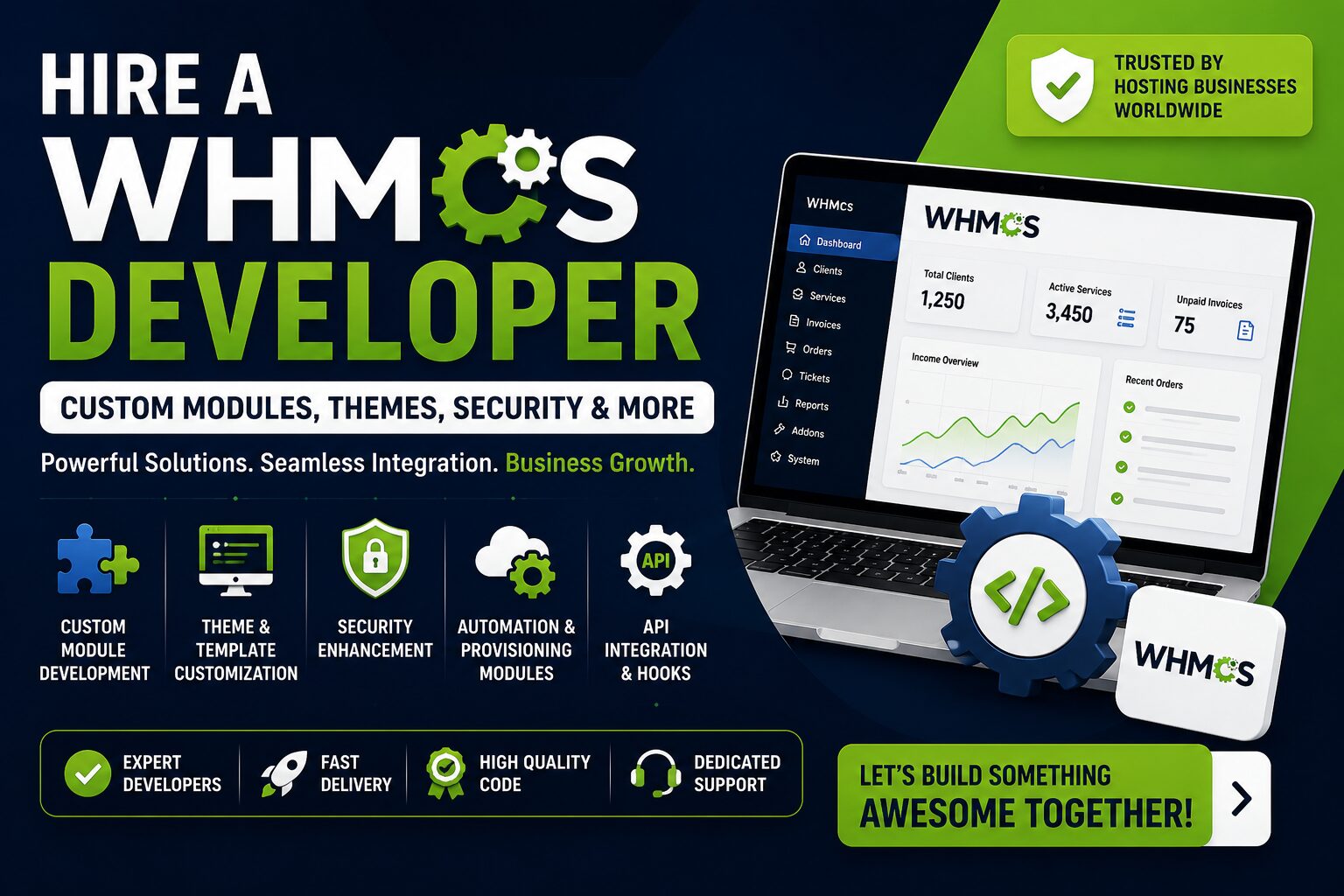
Most hosting and OTT businesses don’t need “a developer” in the abstract — they need someone who can walk into an existing WHMCS setup, understand exactly what’s missing or broken, and fix or build it without breaking everything around it. That’s a narrower skill than general web development, and it’s why so many WHMCS-related projects stall when handed to a generalist.
Here’s what actually falls under “hiring a WHMCS developer” in practice, and where each type of work tends to matter most.
WHMCS installation & setup
A clean install is the foundation everything else depends on — server configuration, database setup, cron jobs, SSL, and payment gateway connections all need to be right from day one. A rushed or DIY install is one of the most common reasons hosting businesses run into recurring bugs months later that trace back to a misconfigured setting nobody caught at launch.
Custom module development
Off-the-shelf WHMCS covers the basics, but almost every hosting business eventually needs something the default install doesn’t do — a custom provisioning flow, an internal tool integration, or automation specific to how your team actually works. Custom module development is about extending WHMCS to match your business, instead of forcing your business to match WHMCS’s defaults.
WhatsApp notification module
Email open rates for billing and support notifications hover around 20-30%; WhatsApp’s sit closer to 98%. A WhatsApp notification module routes invoice reminders, payment alerts, and support ticket updates through WhatsApp instead of an inbox clients barely check — directly cutting down on late payments and “I never got that email” support tickets. (See how this works in more detail →)
Server security module
Hosting infrastructure is a constant target — brute-force login attempts, malicious signups, and automated fraud on payment gateways are daily realities, not edge cases. A security module built around your specific stack can add rate limiting, fraud detection on new orders, two-factor authentication, and audit logging — the kind of protection generic security plugins don’t fully cover because they weren’t built for WHMCS’s specific workflows.
WordPress website development
Most hosting businesses run their public-facing marketing site on WordPress alongside their WHMCS billing panel, and the two need to work together cleanly — consistent branding, a smooth handoff from the marketing site to the client portal, and no jarring gap in experience between “reading about your service” and “actually signing up for it.”
WHMCS client area theme designing
The client area is where customers manage their billing, tickets, and services — often the single most-used part of your entire platform. A generic, unstyled default theme makes even a reliable hosting business look outdated. Custom client area theming brings the portal in line with your brand and makes day-to-day account management feel like a natural part of your product, not an afterthought bolted onto WHMCS.
OTT theme designing
For businesses running an OTT (streaming) platform alongside WHMCS billing, the viewer-facing theme needs to feel like a media product — not a repurposed hosting template. OTT theme design focuses on content browsing, playback experience, and subscription management working together as one cohesive interface, rather than a billing panel awkwardly wrapped around a video player.
OTT module development
Beyond the theme, OTT platforms usually need functionality WHMCS doesn’t ship with by default — content access tied to subscription tiers, integration with streaming/CDN infrastructure, device management, or custom billing rules for regional pricing. OTT module development fills that gap so the subscription and content-delivery sides of the platform actually talk to each other correctly.
Why one developer across all of this matters
Each of these can technically be hired out separately — a WordPress freelancer here, a security consultant there, a theme designer somewhere else. But WHMCS-specific work has a lot of shared context: how the client area behaves, how modules hook into billing events, how the database structures orders and services. A developer who already knows that context moves faster and breaks less than someone piecing it together project by project.
If you’re evaluating whether to bring in help for one of these specifically, or need several of them handled together as one connected setup, that’s exactly the kind of work a dedicated WHMCS developer is built for.